Friday, January 21, 2011
Where are the bekantan and the Borneo?
I have been writing this blog for 3 months now, and you might have noticed that there is little to no mention of bekantan (proboscis monkeys) or even the island of Borneo. That is because I have spent the last 3 months collecting permits, avoiding large exploding volcanoes, and learning a little Bahasa Indonesia, all on the island of Java. However, this is all going to change because next week (aka tomorrow), I am scheduled to return to Borneo. The crowd cheers, yah!!!! I figured I would take this opportunity, while I still have free 24 access to internet, to explain why I am going to Borneo. I have two main projects that I am trying to accomplish, I call one my conservation project and the other my science project... both involve the awesome, amazing, incredible proboscis monkeys (aka the bekantan). For my conservation project, I am attempting to evaluate how different conservation projects protect both the proboscis monkeys and the local people. I will be specifically looking at an ecotourism project, a national park, a carbon credit trading project and an area with no conservation projects. I am particularly excited to look at the carbon credit trading project because it has the potential to have a huge impact on how we do conservation in the future. For my science project, I am looking at how proboscis monkeys response to variation in food availability (both variation due to seasonal changes, and also variation due to human caused alterations to habitats). I will be measuring how proboscis monkeys change their feeding, their ranging and travel patterns, their grouping, and their activities. I am very excited to return to the field, and will try to keep you all updated on the progress I make. Hopefully from now on, there will be a lot more bekantans and Borneo in this blog.

Sunday, January 2, 2011
Living in the Ring of Fire
 On December 18th, I did something that I am not proud of, yet something that I am glad I did. I participated in disaster tourism, particularly; I visited the site where Mount Merapi devastated many villages when it had its worst eruption in recorded history. Disaster tourism is a new thing in Indonesia; it is a way for the country to bring in funds after being struck by natural disasters, like tsunamis, earthquakes, and volcanoes. I personally am against the idea; however, I felt that I had to go to Merapi because of our history together. Mount Merapi, one of the most active volcanoes in Indonesia, erupted my second day in Indonesia. The eruption continued and intensified for my first month in country, to the point that Fulbright evacuated all Fulbrighters living in towns near Merapi, included the location of my language school. The continual eruption of Merapi controlled my life for the first month in country, it dictated where I could go, when I could go there, and for how long I went there. When given the chance to see Merapi in person, I had to.
They say a picture is worth 1,000 words. I have about 200 pictures (that I took over a course of 2 hours), so no wonder this blog post might be a little longer than my normal ones. However, when I was up there, I had to take pictures. It was my way of coping. If I was behind my camera, it made the things that I saw easier, it was like it wasn't real as long as I was looking through my camera. For those of you that have known me for a long time, you might remember a period in my life when photography was a very large part of it. I did not go anywhere without my camera. However, when I entered college, I gave up photography completely. I was tired of living through my camera lens and wanted to actually live life, not just capture life. The necessity of my work, and my generous parents, combined for the purchase of a brand new camera. That combined with my desire to create something and contribute something to society rather than just science has rekindled my interest in photography.
 I feel that I am in a special position that gives me the opportunity to travel to unique places and do my work. One of the purposes of my work is to analysis the interaction between humans and nature, particularly primates. I have realized that there are stories that have to be told; the stories of things and people with no voice. There is the story of the monkeys losing their habitat, there is the story of the people who are trying to make a living along side some of the areas with the highest biodiversity, and today there is the story of the people that lost their lives, both physically and metaphorically to a natural disaster. This is my first story… I hope I have the opportunity to tell more.
The story begins with a very early morning at a certain homestay in Yogyakarta. After leaving the house at 6am, we traveled past sights that I have grown accustomed to from living in Indonesian cities for two months: mopeds zipping by, Baceks (Indonesian word for riksaw) pedaling away, and cell phone shops and warungs (local food stands) lining the streets. However, the early morning traffic quickly thinned and the views out the window became more of the scenes that I imagine when I think of Indonesia. Narrow streets lines with rice padi fields and banana plants, people in multicolored sarongs walking with loads of the seasonal crop on their back, and old men riding down the road on his bicycle. The green from these sights was so blinding… I had forgotten how green Indonesia is. However, the green disappeared as quickly as it arrived. Just 12 miles from the house that I live in, we reached the entry way for the Merapi Eruption Tourist Site. We passed through a bamboo gate and everything was so different, it was like the small gate was not just to stop cars to collect their entrance fees, but instead a passage way to an alternative reality. It was so shocking, I actually gasped for air.
 The first thing that hit me was the nothingness. We went from a very densely vegetated area to an empty area with blackness. As we traveled up the road, we saw ruminants of what used to be peoples’ lives. Three motorcycles that looked like they had been discarded years ago, nothing but rusty frames remained… however, just a month and a half ago these were fully functioning bikes. We parked on the side of the road and got out of the car. A cool strong breeze hit me as I exited the car, reminded me of the power of nature, the power that caused all this destruction. The landscape lacked the vibrant color of life that I saw on the way up, and everything that was in the path of Merapi was black.
The only color on the scene was the items the relief workers brought in (brightly colored water tanks, tarps, and even makeshift bathrooms). Next, I realized that things were not burned. Merapi is known for its plumes of toxic hot gases, rather than its lava. Therefore, most of the damage was from things melting and corroding away rather than being burnt. As I began to walk around, it was interesting to see the things that survived. Notebooks that had warped under the heat of the volcano but were otherwise intact with notes and scribbles of school children, while cars were just destroyed. As I looked at the mountain side, bright green trees stood in contrast to the dark paths of nothingness, marking the fury of the volcano. I wander around taking pictures, trying to capture the devastation and power of nature… but as I look at the pictures today and they don’t even begin to give the site justice.

After about 20 minutes of walking around, I went back to my host mom and friend. They were talking to an elderly lady that was standing in front of a makeshift snack bar. I assumed she was just another person trying to make a profit on the natural disasters like the people selling videos and t-shirts. I soon realized that she was not trying to make a profit but instead she was guarding the last remains of what was left of her life. She began to tell me her story, and I realized that communication in humans means so much more than just formal language. Although I could not understand most of the words that she told me I completely understood the message of the story.
 She told me her story in her eyes, the way that the tears welled up in her eyes reflected the destruction of what was around her, she told me her story in her shoulders that were slumped under the burden of having her life destroyed by a volcano and she told me her story in the quiver of her voice as she described how she used to live here, and how that life was now gone. I felt like she needed a hug, someone to hold her, to help support the weight of tragedy that she carried in her already frail body; however, I did not know how culturally appropriate it was. I reached for her hand as my eyes filled with tears to tell her I understand, and maybe try to give her hope. Besides not knowing the words in Bahasa Indonesia to comfort her, I really didn't have the correct words in any language. There are no words in any language to bring relief to someone who lost so much. It was in that lady that I started to understand what the eruption of Merapi really meant. My host mom told me it was time to go, and as I left the lady, she started wandering around, lost in a place that she once knew so well.
  As we followed the brightly colored yellow Merapi Tourist signs to the exit, I was able to have glimpses of how one begins to rebuild their lives. Men worked on digging out the ash and debris that used to occupy someone’s living room. That family was left with two walls and with a little hard work and money; they might be able to repair their house. Further down the mountain, there was a house that was missing a roof and a large portion of a wall; however, it had clean brightly colored clothes hanging on the line. To start to rebuild, one does what they can, anything to return life to normalcy, even if that normalcy is hanging your wash in the front yard, back when there were actually things in your backyard.
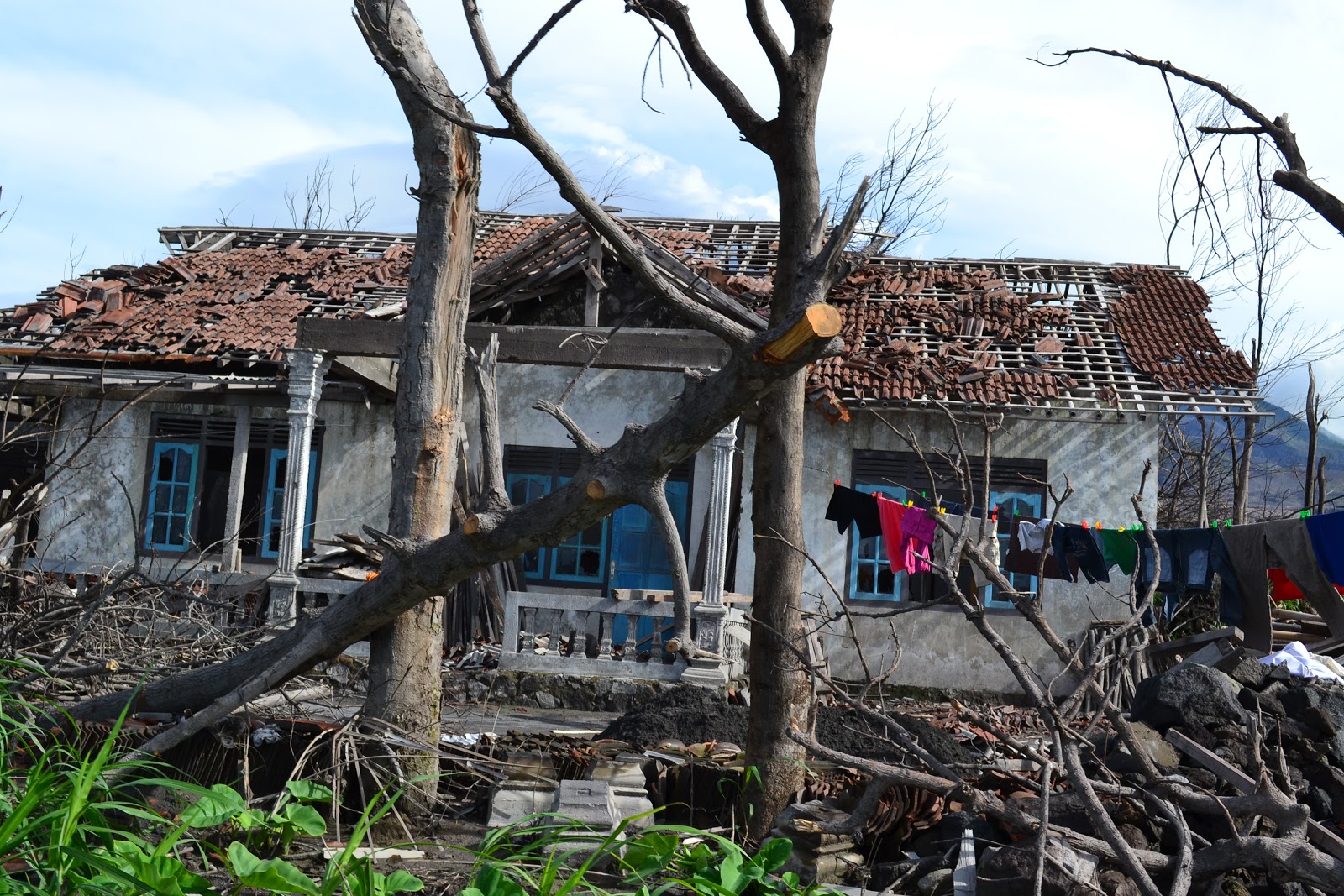 As quickly as we entered the disaster area, we left it and were traveling through brightly colored rice fields once again. These people were lucky and didn’t lose everything; however, the terror of the volcano changed them. Houses upon houses had for sale signs on them. For those people, they decided that it was best to try to rebuild a life that was not in the shadow of a volcano.
 Sunday, December 26, 2010
Merry Christmas from Indonesia
It is Christmas Eve in Indonesia, and I am sitting in my room listening to Christmas music thinking about this holiday. From my calculations, this will be my fifth Christmas spent aboard; I have spent Christmas in Taiwan, Paraguay, Panama-Costa Rica, and now Indonesia. I am always intrigued how different cultures celebrate or don't celebrate this holiday. In the small village of Paraguay that I lived in for two years, Christmas was about spending time with family. We would get together and eat and drink and be merry. In the village there were no Christmas trees, no presents, just family and food... oh and fireworks. Santa did not exist; however, on the day of the Three Kings (aka my birthday) the children received small presents. I thought it was strange when I went into the capital city that Coca Cola had a huge Santa Sleigh that drove around the city even though most Paraguayans didn't really 'do' the whole Santa thing. As I was listening to my tape of Christmas music on my Walkman (yah you can do the math and laugh, I was using a Walkman in 2003) washing my clothes by hand in the hot Paraguay sun, I laughed as I listened to White Christmas. Paraguay celebrates Christmas in the middle of summer, it was 110 degrees Fahrenheit. Who decided that the birth of Christ should be symbolized by snowflakes and evergreen trees (as my minister friend pointed out, Jesus was born in the Middle East... also not a cold place)?
This year, I wasn't expecting much from Christmas. I knew I would be spending it in a country that is predominantly Muslim. However, as I walked around town, I was surprised by how many Christmas Trees, signs wishing people a "Salamat Natal dan Tahun Baru" (Merry Christmas and Happy New Year), and store workers wearing Santa hats. I even saw fake snowflakes (which always weirds me out since most people here have never even experienced snow in their lives). In a country that is 88% Muslim and 8% Christian/ Catholic why was there such a 'Christmas' presence? Although the commercial cultural might accept Christmas, the religious meaning of this holiday was not as universally accepted. Churches were searched for bombs and police stood watch as Christians tried to celebrate an important day in their religion. This was definitely a side of Christmas that I had never seen before. I decided for my protection, that going to church would not be part of my Christmas Celebration this year. Instead, I would watch Christmas movies and spend Christmas electronically with my family (video conferencing is a great thing).
No matter where you are in the world, or how you choice to celebrate it, I wish everyone a very happy and safe holiday season.
This year, I wasn't expecting much from Christmas. I knew I would be spending it in a country that is predominantly Muslim. However, as I walked around town, I was surprised by how many Christmas Trees, signs wishing people a "Salamat Natal dan Tahun Baru" (Merry Christmas and Happy New Year), and store workers wearing Santa hats. I even saw fake snowflakes (which always weirds me out since most people here have never even experienced snow in their lives). In a country that is 88% Muslim and 8% Christian/ Catholic why was there such a 'Christmas' presence? Although the commercial cultural might accept Christmas, the religious meaning of this holiday was not as universally accepted. Churches were searched for bombs and police stood watch as Christians tried to celebrate an important day in their religion. This was definitely a side of Christmas that I had never seen before. I decided for my protection, that going to church would not be part of my Christmas Celebration this year. Instead, I would watch Christmas movies and spend Christmas electronically with my family (video conferencing is a great thing).
No matter where you are in the world, or how you choice to celebrate it, I wish everyone a very happy and safe holiday season.
Friday, December 10, 2010
The PhD Candidate Goes to Kindergarten
When I have been staring at my glowing rectangle (aka computer) writing grants, my mind often drifts to days gone by when school seemed so much easier. I remember fondly the days when school consisted of coloring, reading picture books, and playing. The past two weeks of language school has allowed me to go back to those care free days of education when one's hardest task was learning colors, numbers, and how to make simple comparisons of which lady is fatter and which tree is taller. It seems like it should be one of the easiest times in the journey to obtain my PhD. I should have mastered such things as telling time and reading numbers years ago, therefore I just need to learn the words in a new language. Well, the truth of the matter is that I have forgotten that I was not a good student till about the 5th grade, I really struggled with grades 1-4... and all those things I struggled with are coming back to haunt me.
Spelling, I can't spell in my own language that I have been speaking 'fluently' for 29ish years... how am I supposed to spell in a language that I have been learning for two weeks. I get really excited when I am one or two letters off (that means spell checker will know what I am talking about) but the language teachers do not see that as acceptable.
Telling time, I have decided long ago that a digital watch is the best method for telling time. It is quick, it is exact, and it has Indiglo. However, my language teachers insist that I practice my telling time words on a real clock. "Wait a second, which one is the hour hand and which one is the minute hand... and each number is worth how many minutes." To add insult to injury, they tell time here by saying 27 minutes till whatever o'clock, so I had to remember my simple subtraction skills also.
Left and right, I never learned my left from my right. I blame it on having pneumonia for a few weeks during kindergarten. We had multiple lessons where I had to use this skill...which person is standing to the right of Dewi, do you turn left or right if you want to go to the post office, and is the bank located to the left of the police station. I really struggled with those days. It was a constant, left, I mean right, I mean hmm, can I just say North?
I tried to explain to the teachers that it is not the language that is hard for me, it is the basic life skills that I some how missed mastering when I was younger. They don't get it and assign me piles of worksheets to do for homework, which I need to write neatly (another skill I did not master). It is a strange predicament indeed to go from planning research that has never been done before to having to answer, "The color of my shirt is blue." "Your pencil is not red." Given the choice, I think I would prefer to go back to reading journal articles and writing grants.
Tuesday, November 30, 2010
Sampai nanti Bandung
As the hot lava and ash of Volcano Merapi return to mere magma underneath the earth's crust, I too return to Yogyakarta to resume language school (and in return, I mean arrive for the first time). That means a fine farewell to the city of Bandung, the place I called home for a mere two weeks. I figured a photo montage would be the perfect way to say goodbye to Bandung.
 |
| Goodbye outlet malls with funny English names. |
 |
| Goodbye indoor waterfall in guest house. |
 |
| Goodbye traffic jams. |
 |
| Goodbye Institute Technology of Bandung |
 |
| Goodbye parking lots full of mopeds. |
 |
| Goodbye to randomness that can not be properly captured on film. |
Tuesday, November 23, 2010
I am a monkey
I am currently working on learning my fifth language. One would think that I would be a master of learning languages by now; however, I am constantly amazed at how long it takes to learn a language. Although I have been in Indonesia for a month now, I have only had five days of language school (permits, volcanoes and animal sacrifice holidays delayed my formal language training). While I was not in language school, I have been trying to teach myself a few things about the language. Since people often want to know why I am in Indonesia, I figured I should teach myself how to talk about my research. In Bahasa Indonesian, there is only one word for my, mine, and I, the word saya. I figured that I could just replace any of those words for saya and it would work. Therefore, if I wanted to describe the species I studied, I would say, "Saya monyet bekantan". I thought I was saying, "my monkey is a proboscis monkey". Well, yesterday, I found out that to say "my", you need to put saya after the noun, not before. Therefore, when I thought I was saying, "my monkey", I was really saying, "I am a monkey". Now, I am not going to deny that I am a primate, but I am pretty sure that I am not a monkey...the last time I checked, I didn't have a tail. Oh, did I make my language teachers laugh. Little did they know that I am been calling myself a monkey, a house, a book, a motorcycle, and luggage for a month now. I understand why so many Indonesians give me such strange looks. They must have thought I was really confused or having a very bad existential crisis. As I continue my formal language, I am excited to learn how many other things I have been saying incorrectly for the past month.
Sunday, November 21, 2010
The search for java in Java
As an avid coffee drinker, I was super excited to move to Indonesia, as it could be considered the Mecca for coffee drinkers. Just think about it, the slang word for coffee, java, is the same name as the main island in Indonesia, Java... a coincidence, I don't think so. Wikipedia just told me that Indonesia is the fourth largest coffee producer in the world. Besides the whole Java thing, I love Sumatran coffee. As we have learned from Sophia's trivia, Sumatra is one of the main islands in Indonesia. There has to be amazing coffee in this country. When I took my first sip of coffee in Indonesia, it was amazing. I thought to myself, "I am home". However, the next day, the coffee was watered down and never met my expectations. I have set out for the perfect cup of coffee, and a month has past, and I have yet to find another amazing cup of coffee. Usually, when I ask for coffee, I will see them open up the little package of instant coffee and just add hot water. Really!?!?! Instant coffee on the island of Java, this can't be happening. I decided that maybe I just needed to go to the supermarket. I found the aisle of coffee and it was big, real big, this must have the delicious coffee I have been craving. I start searching...instant coffee, instant coffee with cream, instant coffee with sugar, even premixed 3 in 1, instant coffee with sugar and cream, but no coffee beans. Where are the whole beans? I saw the coffee plants covering the mountainsides as I took the train from Jakarta to Bandung...it has to be here someplace. Where are you, oh delicious coffee beans? You must be here somewhere. My search had gone on long enough, it was time to ask for outside help. I asked my language teachers and they said oh we export all our beans and just drink instant here. My heart broke just a little bit. I will not find the perfect cup of java on the island of Java... it is all in the US. I have changed my quest and am now searching for my favorite instant type of coffee, I will let you know when I find it.
Subscribe to:
Posts (Atom)