Eight days a month, four times a day, there is a small
parade on the only paved street that travels through a remote town in Borneo.
The town usually only likes to show up for two of the four parade time slots
(the 4:45am and the 6:15 pm time slots aren’t that common), so at approximately
10:30am and 3:45pm, the residents of this small town gather on porches, as they
anxiously wait for the parade to
begin. You may ask why in a town with
fewer than 30 families there is such a regular parade, and what does that
parade consist of. Well, the answer is
the local celebrity, also known as me.
To me the parade doesn’t seem very exciting, as it consists of me
walking back and forth from my house to the bridge where I dock my boat. However, to the local town children, they
still view this as the highlight of their day.
The children will often run out of the houses or stop their game to say
hello and wave to me. I hear many shouts
of greetings, “Hello Mister” (they haven’t figured out that the expression is
only used for men), “Hello bule” (bule is the general term used for Westerns
but actually means albino), and sometimes if I am really lucky, I even get a “Hello
Katie”. Usually, I will do my princess
parade wave “wrist wrist elbow elbow”, as I stomp down the street in my rubber
boats and camo pants. Recently though,
the parade has become interactive, with the children finally being brave enough
to run to the road and give me a high five. I keep waiting for the novelty of
me to wear off (how long does 15 minutes of fame really last), but 16 months
later, I still hold the position as the local celebrity.
Saturday, July 28, 2012

Wednesday, June 27, 2012
Oh Poop!
There are certain things that happen that remind me that
science might be my correct path. In the
pressure of writing grants, collecting data, entering data, working on
publications, ect, sometimes the day to day (or should I say the data to data) of
it makes me forget the reason why I became a scientist in the first place. For me this week, it was poop that reminded
me. For those of you who know me from a
certain period of my life this statement shouldn’t surprise you. You were there when I was crowned poop queen
many months in a row. For the rest of you, yes there actually is something
called poop queen and yes I have been it, and yes poop reminded me why I
recently repacked up all my possessions to go live in a tent in the middle of a
tropical forest.
So to explain why I found poop so exciting, I need to take a
step back. Recently, I have been on this
path to try to figure out why proboscis monkeys sleep in certain trees and not
others. It has been in the back of my
mind since I started studying proboscis monkeys, but I began formally
collecting data on sleep tree selection, when sleep time was the only time I
actually saw the monkeys. Initially,
this sleep tree project was supposed to be a little side project. It was going to be a finite set of data that
was fairly easy to collect with fairly simple data analysis so I could write it
up quickly or present it at conferences (the dataset for my actually
dissertation seems anything but simple-if anyone knows how to deal with both
temporal and spatially auto correlated data- send me a message); however,
recently my sleep site project has been taking over (maybe there is a
correlation between how much Katie is not sleeping, and how much she is
thinking of primates sleeping). Most of
the literature to date state that most primates select sleep sites as a way
reduce predation risk. This seems like a
fairly reasonable assumption- primates have lots of natural predators (raptors,
snakes, wild cats, to name a few), and if one is going to have to turn one’s
back to predators (or in other words- close its eyes and catch some zzzs), it
is going to want to have some way of reducing the fact that it is sleeping prey. The problem with this idea is that no matter
what the data shows- people just wave their hands and say, “Oh it must be
antipredator behavior”. It could be, and
I am not saying it is not, but as good scientists we should be testing these
ideas and leaving the hand waving to the magicians of the world. So to make an already long story about poop –
a little shorter- I plan to to set up a couple of little experiments to test
some alternative hypotheses of why proboscis monkeys sleep in certain trees
(for those of you that are interested- some other ideas are thermoregulation,
anti-disease vectors, social interactions, or optimal foraging).
To do some of these little experiments, I needed some
proboscis monkey poop. Sure it sounds
like an easy thing to do, just get some poop, but with the fallen logs, dense
vegetation, and quick sand mud, I am having a hard time following the monkeys
in the forest. If one is sitting on a
boat and sees a monkey poop, it is a bit hard to then find said poop on the leaf
covered forest floor (it is so much easier when you are under the monkeys and
they just poop on your head). So you all
can imagine my surprise and excitement when I went to my favorite spot along
the river to bath, and realize that my bathing site is covered in proboscis
monkey poop. Half clothed wet Katie is
jumping up and down in the forest because she found poop. I spent the rest of my time bathing figuring
out what I wanted to do with this poop.
My assistants thought I was a little crazy when still dripping wet,
tangled hair probably accented with leaves (I was too excited to comb my hair
or properly dry off), I go directly to my tent and grab my latex gloves and a
zip lock bag; turn around going back into the forest proclaiming, “Saya temuka
kotoran bekantan! (I found proboscis monkey poop).”
In the end, my little experiment didn’t discover anything interesting;
however, finding a pile of monkey poop did allow me to rediscover my exciting
and joy of science.
Friday, June 1, 2012
The disappearing forest

Tuesday, May 22, 2012
The Saving Grace of Cemeteries
Pythons, crocodiles, jellyfish, venomous snakes, sun bears, tree
falls, religious extremists, and angry logger are just a few of the hazard in
my life; however, the most dangerous part of my job is actually walking on the
street in front of my townhouse. I have
said this to many people and they just laugh at me, but last night, I proved
that this is in fact true. I was taking
my causal stroll back home from my boat last night, when all of a sudden I saw
two sets of headlights coming quickly toward me. As I know my road is not wide enough for two
sets of cars, and I am currently walking on said road, I know I am in
trouble. The bus starts honking at me as
it is heading straight towards me. I
thought some words that aren’t appropriate for this blog, and jumped off the
road, but rather than just going into someone’s yard, there was a fence that
was impeding my escape from being flattened by the bus. I had just enough time to half climb up the
fence, and held on for dear life as I felt the gush of wind created by the bus
as it flew past me. After the bus passed
me, I jumped off the fence that I had climbed, and realized that I had tried to
scale the fence into the cemetery. So it
was the cemetery that saved me from my near death experience with the bus… and
in a week when I saw many men totting rifles, tracks of two crocodiles, and
angry male orangutans, it was the bus that almost got me.
Monday, April 30, 2012
The Turtle Goes on a Motorcycle
The turtle is back.
For those of you that have been reading this blog since the beginning,
you have probably read about the turtle. Basically, imagine a 100 lb person with a 50
lb giant backpack on their back, a 40 lb backpack on their belly, and a Timbuk2
bag thrown over their shoulder (I got rid of my giant black box, thankfully). Well after the success of having the turtle
take a train, I decided to have the turtle try to ride on a moped. For someone who is carrying around their
entire house on their back, the idea of having some additional transportation help
seemed like a great idea (key word… seemed).
Therefore, when my assistant asked if I wanted to be picked up at the
airport, I, of course, agreed. I often
sit and watch the traffic pass by my town and I am constantly amazed at how
many people and things Indonesians can put on a moped. Four people is completely normal (I’ve seen
up to 6), so is carrying building supplies (including 2 X 4’s), hundreds of
durian fruits, or anything else one might need to transport. Therefore, I didn’t think twice about putting
the turtle on the moped. We began our
trip right after sundown and it begin without any problems. The weight was well
balanced, and all I had to do was hold on and relax for the hour and half ride
to my town. Just when I was getting comfortable,
we started going a little faster- and realized that I my backpack had become a
giant sail that was pushing me backwards.
Not only was I holding up the 65 lbs on the back of this small bike (which
of courses shifted so all the weight was hanging off my left shoulder), I was
carrying my other pack like a football (it only had two laptops, a pair of
binoculars and my nice camera- nothing important if it went flying off the
motorcycle). I tried to shift to get
things to fall back in balance- but as I did the entire motorcycle lunged as my
assistant, who is not much bigger than I am, tried to balance the extra wiggly
weight on the back of his bike. As I was
holding on for dear life, and literally, it was probably for my life, I just
kept thinking that since my backpack was soooo big if I did fall off, maybe my
backpack would save me, the irony of my life. By the time we
got back to my house in my little village, I had no feeling in any of my body-
especially the two fingers I was using to hold on the whole time. In the lack of feeling of my body though-
there was a different feeling, the feeling of finally starting to be a little Indonesian. However, there was also the thought that after
getting stuck on a train and then almost falling off a motorcycle, I should
really learn how to pack lighter.
Saturday, November 5, 2011
Worst Job in Science
Every year Pop Sci Magazine publishes a list of the “Worst Jobs in Science.” I usually read the list and scoff at the people who they have chosen. Don’t get me wrong, I love my job. However, if I had a quarter for every time I have been pooped or peed on by a monkey, swarmed by annoying insects (many of them with painful stings), stuck in quicksand like mud, or been in close proximity to venomous snakes, I wouldn’t have to be writing grants. Therefore, it was a strange day indeed when I find someone’s whose job actually might be the worst job in science. The person who wins the award for me is Mosquito Man. Mosquito Man is studying how rates of deforestation influence the transmission of malaria and dengue through mosquito vectors. It is a very important question that has the potential to help thousands (if not millions) of people. However, the work required to collect this important data, sucks (pun intended). First of all, Mosquito Man sits in the forest all by himself from the hours of 5:30 pm to 6:30 am. To the person who likes to be asleep by 8pm, the hours alone sound horrible. However, may I remind you that he is not sitting in an office somewhere; he is sitting alone in the tropical forest. To understand what that means, let me explain to you the night he spent in my forest. First, the forest he was studying became flooded, therefore he was stuck on a 3X3 feet island of trees, as the crocodile infested waters surrounded his previous forest escape path. If that wasn’t enough, he happened to share that island with a 9 inch centipede. For those of you that aren’t familiar with the centipedes of Borneo, their bites are more venomous than many of the scary snakes that also live in the forest (and often visit him). However, that isn't even the worst part of his job. On a good night, he will be bit by a high number of mosquitoes. Remember, these aren’t your run of the mill Wisconsin mosquitoes that produce a nice itchy bite for a few days; these are tropical mosquitoes that carry such fun vectors of malaria (killed 780,000 people last year) and dengue. Since he is interested in the transmission of these deadly diseases, he is actually hoping the mosquitoes that are biting him are carrying these diseases. Talk about having conflicting views about your job. After hanging out with mosquito man, I think I am going to stick to primate research, and am happy to award Mosquito Man as the Worst Job in Science.
Wednesday, October 5, 2011
Top Ten Signs You Have Been in the Field Too Long
I am quickly approaching my one year anniversary of being in Indonesia. Although it has been a great year, I have recently realized that things that have become part of my normal routine and experience are not necessarily normal things for the normal person (I also do not know what a normal person is, but I am pretty sure that I am not normal). Therefore I devised a list of top ten signs that you might have been in the field too long.
10. You don’t leave the house without applying at least SPF 85 and wearing a big hat.
9. You pack everything from electronic equipment to clothes in dry sacs (even when going to the grocery store).
8. You shake out your pants and shoes before putting them on, because you never know who or what might be in them.
7. You think it is normal to have to stand on a tree to get your emails and text messages. It is also normal for Gmail to take over 5 minutes to load, even if you use the version for “slower connections”.
6. A toilet means digging a hole in the woods. You haven’t seen a sit down toilet that flushes in a couple of months. Showers are what you do with a bucket, often next to a river wearing a sarong.
5. You are so accustomed to wearing your binoculars every day, you often reach for them even when you are in town (when you start wear your binos in town, you know it is time to go home).
4. You forget that normal people don’t live in their tents. Sleeping in tents is a thing called camping, not real life. The same goes for not using your camping sleeping pad as an everyday mattress.
3. You can’t remember the last time a part of your body... hold on, I am scratching... didn’t itch.
2. It is an extremely special and rare event when you can drink beer, eat chocolate, and speak English.
1. Seeing amazing and unique things becomes so mundane and normal, you can’t come up with anything to write about for your blog.
Sunday, July 17, 2011
Guest Blog from CIM
Rather than talking to myself for another blog, I decided to have someone else do the talking for me. My fellow monkey lover, CIM, and her partner came to visit me... here is their story.
According to the rain gauge, there has been more than a meter and a half of rain in the last 12 hours. It rained off and on all night. When the deafening sounds of the rainstorm on the tile roof quieted they were replaced by frogs bleating like sheep in surround sound. It sounded like they were tucked away in every corner of the house. We were supposed to be on the boat by 5:30 this morning but the rain has kept us indoors. It’s been raining off and on for the past four days and this is supposed to be the dry season!
Jake and I are visiting my friend Katie in Indonesian Borneo (or Kalimantan Barat) for a few weeks. Katie has been here since last October and has learned the local language, Bahasa Indonesian, quite quickly, which is necessary because not many people speak English. (We made sure to bring gifts of cheese and chocolate to pay for her translator fees…) She’s here studying the proboscis monkeys – orange pot-bellied monkeys with protruding noses that are endemic to Borneo’s riverine systems. Not much is known about the species in general, much less about the population here in Kalimantan Barat. Katie lives with a local family in the small coastal town of Tolak. It’s not the easiest of places to reach from the Southwestern US. We took four flights spread out over a day and a half to reach Jakarta, Indonesia’s capital located on the island of Java. From there we flew to the island of Borneo, spent the night Pontianak (Kalimantan Barat’s largest city), took an hour long flight to Ketapang, and finally jumped on a bus for an hour before arriving at the house three days after we left our own back in Tucson. From here camp is still another 18 km up the Sungai Tolak (Sungai means river in Bahasa) by long boat.
“Camp Katie” is not much more than a small cleared area on the river that Katie and her two local assistants claimed for themselves. There are no permanent structures other than a wooden table, bench and a swing. There is a lot of logging traffic on the river and multiple small encampments perched along its banks. It has been disheartening and hard to escape the constant sounds of chainsaws creating destruction in the surrounding forest. We spent our first four days up at “Camp Katie” and were treated to some of Borneo’s many treasures as well as hot and dry weather. We had some great views of many of the river’s primate species, including an acrobatic water show starring a rather large group of proboscis monkeys. We stopped to watch a group along the river and quickly realized there were monkeys on both sides of the water. Not before long a few daring monkeys started diving out of trees into the river below and swimming to the other side. The most timid of the group slunk in at the shore and soon there was a steady stream of monkeys with their long noses above the water, swimming in a line to the other side. It was amazing!
We’ve been looking forward to a glimpse of Asia’s only great ape, the orangutan. Appropriately enough, orangutan means man of the forest in Bahasa. Katie doesn’t see them on a regular basis but she has, and they are here so we have been continuously scanning the trees for a large orange man of the forest. Our third day on the river we parked the boat and went for a walk on a logging trail in the forest. We lost track of Jake early on because he was busily snapping photos of every bird he came across. Katie and I decided to stop and wait for him to catch up. Not far from where we were standing something fell from the tree tops. Then something else fell in the same place. It wasn’t a group of monkeys; they make more noise and shake the foliage when they jump around. This thing wasn’t moving much but there was definitely something up there. We looked at each other without saying anything, I’m sure we were both thinking the same thing, and scrambled around the undergrowth for a better vantage point. And there he was, a giant flanged male orangutan high in a tree feeding on stinky durian fruit. Jake caught up with us and we all watched the orangutan feed for quite some time. Orangutans have no natural predators so it wasn’t surprising that he didn’t seem bothered by our presence in the least.
Jake has been hard at work identifying and recording every species of bird he can and has come up with a sizeable list for Katie’s site. I’ve been busy pointing out and counting monkeys as we cruise down the river in the long boat. We are hoping Katie hires us in the future as assistants…
Katie took a break from work and we went north to Gunung Palung National Park for a three day expedition. We saw three more orangutans from our camp, a bunch of singing gibbons, radiant red-leaf monkeys, huge hornbills, glowing mushrooms, pygmy squirrels you could put in a coin purse, blood loving leaches, and monstrous insects. Camp was not what we were lead to believe it would be, Jake ended up sleeping on the floor by the French tourists, Katie and I shared a plywood platform, and the hike in and out was a little crazy with our packs. We are still kicking ourselves for not bringing the sleeping pads but really glad we had mosquito nets. Regardless, for what we saw, it was worth it. We spent our last night of Katie’s vacation down in Ketapang running errands, most importantly finding some cash as we nearly ran out of money and couldn’t find a working ATM near the park. Plus we wanted to eat extravagant foods like ice cream and burgers washed down with beer, a welcome break from the rice, veggies, and tempe we’ve been eating three times a day for the past couple weeks.
We are going to spend four more days in the field with Katie…if it ever stops raining. Then we are headed to Lombok and Bali to experience a very different side of Indonesia.
All the best from Borneo,
Corey and Jake
Saturday, June 11, 2011
Interview Part 2
Katie: Hi KT, welcome back to our interview.
KT: Yes Katie, I apologize for the delay. It is very hard to coordinate our schedules.
Katie: So we actually received a few questions from our readers while you have been gone.
KT: Oh really?
Katie: Well, actually it is the same question asked by a couple of people, so I guess that is a good place to start.
Q. What is a typical day for you?
A. That is actually a really hard question to answer, it would be better to answer it with a flow chart, but this blog doesn’t support flow charts. The answers depend on where I am and what type of data I need to collect that day. The one consistency is that I usually wake up at about 4am and I am in bed (usually reading) by 8pm. Besides that, I try to keep a 4:1 schedule, which means four forest days and one data day. Many people would mistake my one data day as a day off; however, I often spend 10-14 hours on those days entering data, cleaning data, and writing reports (besides the necessary bucket washing of clothes). For forest days, I have three different types of days: phenology days, census days, and bekantan behavior days. On phenology days, we go to one of the four transect (scientific word for path in the forest) and record what the trees are doing. They are often dancing and having lots of sex…you know, being crazy and throwing poop at researchers… wait that doesn’t seem right, these are trees not monkeys. Really, we record if the tree is fruiting, flowering, or has new leaves. I use this data to figure out what foods are available for the monkeys to eat; it also allows me to monitor if the loggers have cut down any of my trees. On census days, we walk the same transects, but instead of looking at trees, we look at monkeys and other mammals. This data will let us determine the densities of both the proboscis monkeys and other animals in the area. On behavior days, we spend a lot of time looking for monkeys in the boat. When we find them, we keep them as long as we can. These activities all take place in the morning from about 5:30am to about 10:30-11am. We then usually have a break, eat lunch, and then at about 3:30-4pm we head out to collect sleep site data. Anytime between 6-7pm we return to our selected sleep site of the night, eat, bath, and go to sleep.
Q. What do you usually wear in the forest?
I am the height of fashion in the forest. My favorite pair of field pants is pair of old camouflaged military issue pants. If we are going to walk in the forest, I wear my giant camouflaged rubber boats (they are of course a different pattern than my pants), however if we are staying in the boat, I often go barefoot. On top, I usually wear a wicking t-shirt, with a long sleeved shirt over that (I have a blue one, a coral one, and a beige one… they all match great with my pants). Although it is often 90 degrees, it is important to wear long pants and shirts for sun and bug protection. I accessorize my outfit with my binoculars, my giant green hat or fun colored bandana (depending if we are walking in the forest or on the boat) and my pink cut off angel rainbow gloves (I have scars on my hands from the sunburn I got on my hands the first month- I guess SPF 75 sometimes just isn’t strong enough). This field season, I have switched from my backpack to a fanny pack. Besides trying to bring back the 80’s, the fanny pack is much cooler (temperature and style wise), and also I don’t get neck strain when looking up into the canopy. I am really waiting for Jungle Chic (what I like to call my style) to pick up in the Jakarta Clubs.
Q. What are the things that you miss the most?
A. Besides my family and friends, I miss cheese the most. There is absolutely no cheese in my town, only really bad processed cheese (so processed it doesn’t need to be refrigerated) in Ketapang (1.5 hour bus ride away), and bad expensive cheese in Pontianak (8 hour ferry ride away). In regards to other food, I also miss bread, and related bread products. I especially miss the coffee house snacks, and lab mate’s and office mates’ bakery goods. Finally, I miss intellectual thought. As you can tell from this self interview, I talk to myself a lot. However, it would be nice to have someone else’s ideas every once in awhile.
Q. You have had 2 sets of visitors now, are there any observations they made about your life that you didn’t pick up on?
A. First, my visitors said they would write a guest blog (hint hint), so I am sure they will share with you all their insights. However, the one thing that both sets of visitors noticed was that I have nothing soft (or remotely comfortable) to sit on. On my boat, I sit on hard wood planks, in my house, I sit on the concrete floor (even when eating dinner), and in the forest I sit on logs. After they mentioned it, I remember being slightly in pain when I arrived, but I guess I have just developed butt pads (does this make me now a monkey and no longer an ape?). Also, I have forgotten that in America, we only eat certain foods at certain times of the day. For example, it would be strange to have fish in a curry sauce for breakfast in America. However, here we eat the same thing three times a day.
Sunday, April 17, 2011
The Three- Hour Tour
In my youth, whenever I would go on a boat tour with my father, he would start singing the theme song to “Gulligan’s Island”. The other day, my assistants and I went on a little Three-Hour Tour… and sure enough the theme song to Gilligan’s Island was in my head when we started. It all began innocently enough, I was feeling like I didn’t have enough work to do with starting two research sites (why only work 14 hours a day, when you can work 18), that I figured I should check out a possible third site. The good news was that I could use my own boat to get to and explore the new site; the bad news was that we had to go out to sea to access the third river. We arrived at the new river safely without any problems; after finding five proboscis monkey groups and buying some fresh fish at a boat thru fish shop (shop is a very generous word, basically a guy standing next to a cooler on a dock), we decided to head home. As we approached the sea, I realized that this was not going to be a boat ride on smooth seas. I quickly wrapped all expensive electronic equipment into their various dry bags and boxes, tied everything down, and prepared for the ride. We entered the sea, and when the first wave came over the edge of the boat…. I thought “Oh that wasn’t that bad”. Then the second one came and smacked me in the face. “Hmmm, sea water, good for the skin”. As we headed out to sea, the waves started getting bigger and bigger, till the swells were about 3 to 5 feet. Then just when I thought it couldn't get any worse, the winds started to pick up, the sky turned an eerie shade of dark grey, and it started to pour. There is wet, and then there is really wet, we had passed the point of being really wet, as my entire body had already started to prune. As my teeth began to chatter, and I started thinking about how I could use my dry bags as floatation devices (shhhh don’t tell my mom, but I didn’t have my life jacket with me), my assistants (who don’t know how to swim) decided that maybe it was time to turn back. As we arrived back to the town of exploration, the people we bought the fish from were laughing when a very water logged American got off the little boat. Now you would think the story ends there… but the American can’t sit under an awning of a building in the pouring rain. One of my assistants found a motorcycle to borrow, to transport me back to our house. Funny thing is that now he insisted that I put on my poncho (had the poncho the whole time, but it was covering my equipment), and I prayed that the end of this adventure was not going to end in a motorcycle crash (since my helmet was sitting at home with my life jacket). Eight hours of wearing my polar fleece, wool socks, and skiing liner gloves, I finally shopped shivering... and you all laughed at me when I packed that stuff to live at 1 degree south of the equator. Needless to say, I might be sticking to only two sites.
Wednesday, April 6, 2011
Interview Part 1
So I posted a blog asking for questions; however, I received no questions. That means that no one actually has any questions, no one is actually reading my blog anymore, or people have questions but keep forgetting to ask them (I wrote this before I got my one question… which I will answer). Well, it really doesn’t matter which one of those things it is. These days, I talk to myself a lot as I am the only one who speaks English or Spanish (two languages I feel fluent in) in hundreds of miles; I try to speak to the Indonesians in Spanish and they just look at me funny. Anyways, I talk to myself, so I figured I would just interview myself, since I have some questions. Here is part one of my interview.
Hi KT, thanks for taking the time to sit down for this interview, I know you have a busy field schedule.
Oh thanks Katie, but it is my pleasure to take the time and share my research with others.
Q. So to start off with let us cover some of the things you have mentioned in your previous posts. First, are you still eating nasi goreng or has your diet changed?
A. Oh yes, my diet has changed a lot. I like to divide my diet into 4 food groups, rice, msg and salt, eggs, and noodles. Plain white rice is a staple in Indonesian food; they like to say, “if you didn’t eat rice, you didn’t eat”. Sometimes, rather than rice, we will eat ramien noodles, but usually it is noodles with a side of rice. An Indonesian in my village would have a diet of rice and fish; however, since I still don’t eat fish, I eat eggs instead. Oh yes, and msg is added to everything. When I am living in town, I keep trying to buy veggies (which are rare and hard to come by); however, my host mom doesn’t really know what to do with them.
Q. Have you found any better coffee now that you are off the island of Java?
A. Yes, I have, but it actually has very little coffee in it. My host mom makes this thing called kopi campur which translates to country coffee. It is roasted fresh coconut, rice, and a little coffee. It is pretty good, much better than instant.
Q. What is the hardest part of your job?
A. Many people would think it would be the snakes, or the heat or maybe the bugs, but I would have to say the loneliness. When I was at school, everyone around me was working on a post graduate degree. They understood the stress, the frustration, and the drive. Currently, I am living in a town with a fairly poor population; most of the adults have a 6th grade or maybe 9th grade education. Therefore, to have someone who is not just working on a college degree but a PhD is a bit isolating. Add on top of that, I come from a very different country with a very different culture. The loneliness is compounded by a ‘lack of understand’. I can explain the lack of understanding in three ways. First, although my Indonesian is getting better, there is still stuff that I just don’t get yet or can’t express. Secondly, the people do not speak Indonesian to each other; they speak this local language (which of course there is no dictionary to it). And finally, there are things I want to express that they just don’t have any concept of. I think the best example of this is when my new thermometer came. I didn’t know the word for thermometer but I showed it to my assistant. He asked me what it was, and I said it is to know the temperature. We ran into my other field assistant who has worked with scientists for years, and he said the word in Indonesian and explained it; however, there was still this question of what it was and why would you need to know the temperature. I guess when your temperature ranges about 10 degrees Fahrenheit the importance of knowing the temperature is less important. There are three temperatures here, digin (cold, under 83 degrees), panas (from 83-90 degrees), and panas sekali above 90 degrees. Therefore even when there are words, sometimes things just can’t be explained. I thank all of you out there who have chatted with me or sent me emails, it really helps the loneliness, and I really appreciate it.
Sunday, March 13, 2011
Is there a doctor in the house?
You can imagine the scene in a sitcom, someone yells for a doctor, and a person replies, well yes, I have a doctoral degree in (name obscure subject here), and cannot really help the situation because what they need is a medical doctor. Well yesterday (now over a month ago), I realized that sometimes the doctoral candidate in primatology is the closest thing to a real doctor within 50 miles and therefore might really be able to help. I was sitting at my makeshift office, working on the placement of my vegetative plots, when there was a distinct noise outside. My host dad/ assistant and I rushed outside and saw there was a motorcycle crash down the way. He told me to wait in the house and went running down the street. Still trying to figure out my role in this society (being an educated female western scientists) in a poor Muslim town, I realized I should listen to him. However, after looking down the street and realizing that people are still milling around the accident scene, I realized that I am probably the most qualified to help. I mean, I have read “Where There Is No Doctor” about a hundred times, taken First Aid and CPR sometime in the past, and have watched enough ER and Grey’s Anatomy to have at least 5% of a medical degree… all of which I have figured the local towns people have not done. So I grabbed my “Wilderness First Aid Kit” (which by the way, I got on super sale at Steep and Cheap) and went running down the road. As soon as I got to the scene, I busted out my plastic gloves and went to work. Relatively speaking, it was a bit disappointing… there were a few cases of road rash (nothing bigger than an inch squared) and a potential sprained wrist…. I didn’t even get to use my butterfly closures. Basically, I cleaned the wounds, put antibiotic ointment on them, and bandaged them up. However, since I was bored, and wanted to demonstrate my expertise, I figured I should address the potential broken wrist. Although I have a really nice ace bandage, I figured I might need that someday, so I made this awesome cast like contraption with a pencil and athletic tape. Both kids (the victims couldn’t have been more than 18 years old) seemed pretty shocked, I think it was less from the accident and more from the crazy white lady with frizzy hair who kept putting more and more creams and ointments on their wounds. Oh first aid and simple medical help, just one of the many services your local primatologist provides.
Saturday, February 19, 2011
Are there any questions?
There aare maany things to talk about; however, my current situation is preventing me from writing (using internet on a phone). I am taking this oppertunity to take any questions you might have regarding my life, the proboscis monkeys, or Indonesia. Please leave me a comment or send me an email.
Sunday, February 6, 2011
Justin Beiber, Smoking, and Monkeys
What do Justin Beiber, smoking and monkeys all have in common? Well these are the words that best summarize my first expedition to the field. If you came up with something else, I would really like to know, because those are three things that I don't think generally go together. So after many delays, setbacks, and false starts, I was finally able to go up to one of my sites, called Batubarat. It is an interesting site because one side of the river is Gunung Palung National Park, while the other side is not protected. Currently, the forest is rapidly being converted to palm oil plantations; however, more on that later.
So back to Justin Beiber, smoking and monkeys. Imagine sitting on the porch of a little wood bungalow overlooking palm trees, a tropical river, and mountains in the background. As you sit amazed at the wonders of natural, you hear a familiar sound... is it a bird, maybe a gibbon calling to its mate, no... it is Justin Beiber's "Baby, Baby, Baby." My assistants (all of which are grown Indonesian men) love this song; they play it when we get back from the forest, they play it when we are eating lunch, they play it while rowing down the river. That song will forever be in my head when I think about Indonesia.
When I first arrived in Indonesia, I was taking aback by how many people smoke. In California, we haven't been able to smoke in bars and restaurants for years, let alone in offices. A few weeks into my stay, I read an article in the Indonesian newspaper about how smoking is not bad for you and all the bad press about smoking is just Western modern colonialism. I hope they are right, because otherwise I have to stop worrying about the crocs eating me and start worrying about dying of lung cancer. I think between my assistants, my homestay parents, and the random town people that stop and visit, I might be up to a 30 pack a day habit. Maybe the large carbon emissions from Indonesia is not caused by deforestation but just from cigarette smoke.
And finally, the good part... MONKEYS!!!! After waiting for more than 2 years to return to the field, my first day back, I was able to spot 2 groups of proboscis monkeys. Granted this is a lot less than the last time I am here (my research will determine the reason for that), but still, I saw that face with the big nose looking at me, before it turned around and ran away. I had 13 sightings of proboscis monkeys in 6. Three of the days, we were in the forest setting up botanical plots so the goal was not to find monkeys those days. I also was able to see long tailed macaques, leaf monkeys, and a tarsier. I saw orangutan nests and heard gibbon calls, so they are there, just hiding. I am taking a brief respite from Justin Beiber, smoking, and monkeys to deal with some permit issues... but will be heading to site number two this week.
Friday, January 21, 2011
Where are the bekantan and the Borneo?
I have been writing this blog for 3 months now, and you might have noticed that there is little to no mention of bekantan (proboscis monkeys) or even the island of Borneo. That is because I have spent the last 3 months collecting permits, avoiding large exploding volcanoes, and learning a little Bahasa Indonesia, all on the island of Java. However, this is all going to change because next week (aka tomorrow), I am scheduled to return to Borneo. The crowd cheers, yah!!!! I figured I would take this opportunity, while I still have free 24 access to internet, to explain why I am going to Borneo. I have two main projects that I am trying to accomplish, I call one my conservation project and the other my science project... both involve the awesome, amazing, incredible proboscis monkeys (aka the bekantan). For my conservation project, I am attempting to evaluate how different conservation projects protect both the proboscis monkeys and the local people. I will be specifically looking at an ecotourism project, a national park, a carbon credit trading project and an area with no conservation projects. I am particularly excited to look at the carbon credit trading project because it has the potential to have a huge impact on how we do conservation in the future. For my science project, I am looking at how proboscis monkeys response to variation in food availability (both variation due to seasonal changes, and also variation due to human caused alterations to habitats). I will be measuring how proboscis monkeys change their feeding, their ranging and travel patterns, their grouping, and their activities. I am very excited to return to the field, and will try to keep you all updated on the progress I make. Hopefully from now on, there will be a lot more bekantans and Borneo in this blog.
Sunday, January 2, 2011
Living in the Ring of Fire
 On December 18th, I did something that I am not proud of, yet something that I am glad I did. I participated in disaster tourism, particularly; I visited the site where Mount Merapi devastated many villages when it had its worst eruption in recorded history. Disaster tourism is a new thing in Indonesia; it is a way for the country to bring in funds after being struck by natural disasters, like tsunamis, earthquakes, and volcanoes. I personally am against the idea; however, I felt that I had to go to Merapi because of our history together. Mount Merapi, one of the most active volcanoes in Indonesia, erupted my second day in Indonesia. The eruption continued and intensified for my first month in country, to the point that Fulbright evacuated all Fulbrighters living in towns near Merapi, included the location of my language school. The continual eruption of Merapi controlled my life for the first month in country, it dictated where I could go, when I could go there, and for how long I went there. When given the chance to see Merapi in person, I had to.
They say a picture is worth 1,000 words. I have about 200 pictures (that I took over a course of 2 hours), so no wonder this blog post might be a little longer than my normal ones. However, when I was up there, I had to take pictures. It was my way of coping. If I was behind my camera, it made the things that I saw easier, it was like it wasn't real as long as I was looking through my camera. For those of you that have known me for a long time, you might remember a period in my life when photography was a very large part of it. I did not go anywhere without my camera. However, when I entered college, I gave up photography completely. I was tired of living through my camera lens and wanted to actually live life, not just capture life. The necessity of my work, and my generous parents, combined for the purchase of a brand new camera. That combined with my desire to create something and contribute something to society rather than just science has rekindled my interest in photography.
 I feel that I am in a special position that gives me the opportunity to travel to unique places and do my work. One of the purposes of my work is to analysis the interaction between humans and nature, particularly primates. I have realized that there are stories that have to be told; the stories of things and people with no voice. There is the story of the monkeys losing their habitat, there is the story of the people who are trying to make a living along side some of the areas with the highest biodiversity, and today there is the story of the people that lost their lives, both physically and metaphorically to a natural disaster. This is my first story… I hope I have the opportunity to tell more.
The story begins with a very early morning at a certain homestay in Yogyakarta. After leaving the house at 6am, we traveled past sights that I have grown accustomed to from living in Indonesian cities for two months: mopeds zipping by, Baceks (Indonesian word for riksaw) pedaling away, and cell phone shops and warungs (local food stands) lining the streets. However, the early morning traffic quickly thinned and the views out the window became more of the scenes that I imagine when I think of Indonesia. Narrow streets lines with rice padi fields and banana plants, people in multicolored sarongs walking with loads of the seasonal crop on their back, and old men riding down the road on his bicycle. The green from these sights was so blinding… I had forgotten how green Indonesia is. However, the green disappeared as quickly as it arrived. Just 12 miles from the house that I live in, we reached the entry way for the Merapi Eruption Tourist Site. We passed through a bamboo gate and everything was so different, it was like the small gate was not just to stop cars to collect their entrance fees, but instead a passage way to an alternative reality. It was so shocking, I actually gasped for air.
 The first thing that hit me was the nothingness. We went from a very densely vegetated area to an empty area with blackness. As we traveled up the road, we saw ruminants of what used to be peoples’ lives. Three motorcycles that looked like they had been discarded years ago, nothing but rusty frames remained… however, just a month and a half ago these were fully functioning bikes. We parked on the side of the road and got out of the car. A cool strong breeze hit me as I exited the car, reminded me of the power of nature, the power that caused all this destruction. The landscape lacked the vibrant color of life that I saw on the way up, and everything that was in the path of Merapi was black.
The only color on the scene was the items the relief workers brought in (brightly colored water tanks, tarps, and even makeshift bathrooms). Next, I realized that things were not burned. Merapi is known for its plumes of toxic hot gases, rather than its lava. Therefore, most of the damage was from things melting and corroding away rather than being burnt. As I began to walk around, it was interesting to see the things that survived. Notebooks that had warped under the heat of the volcano but were otherwise intact with notes and scribbles of school children, while cars were just destroyed. As I looked at the mountain side, bright green trees stood in contrast to the dark paths of nothingness, marking the fury of the volcano. I wander around taking pictures, trying to capture the devastation and power of nature… but as I look at the pictures today and they don’t even begin to give the site justice.

After about 20 minutes of walking around, I went back to my host mom and friend. They were talking to an elderly lady that was standing in front of a makeshift snack bar. I assumed she was just another person trying to make a profit on the natural disasters like the people selling videos and t-shirts. I soon realized that she was not trying to make a profit but instead she was guarding the last remains of what was left of her life. She began to tell me her story, and I realized that communication in humans means so much more than just formal language. Although I could not understand most of the words that she told me I completely understood the message of the story.
 She told me her story in her eyes, the way that the tears welled up in her eyes reflected the destruction of what was around her, she told me her story in her shoulders that were slumped under the burden of having her life destroyed by a volcano and she told me her story in the quiver of her voice as she described how she used to live here, and how that life was now gone. I felt like she needed a hug, someone to hold her, to help support the weight of tragedy that she carried in her already frail body; however, I did not know how culturally appropriate it was. I reached for her hand as my eyes filled with tears to tell her I understand, and maybe try to give her hope. Besides not knowing the words in Bahasa Indonesia to comfort her, I really didn't have the correct words in any language. There are no words in any language to bring relief to someone who lost so much. It was in that lady that I started to understand what the eruption of Merapi really meant. My host mom told me it was time to go, and as I left the lady, she started wandering around, lost in a place that she once knew so well.
  As we followed the brightly colored yellow Merapi Tourist signs to the exit, I was able to have glimpses of how one begins to rebuild their lives. Men worked on digging out the ash and debris that used to occupy someone’s living room. That family was left with two walls and with a little hard work and money; they might be able to repair their house. Further down the mountain, there was a house that was missing a roof and a large portion of a wall; however, it had clean brightly colored clothes hanging on the line. To start to rebuild, one does what they can, anything to return life to normalcy, even if that normalcy is hanging your wash in the front yard, back when there were actually things in your backyard.
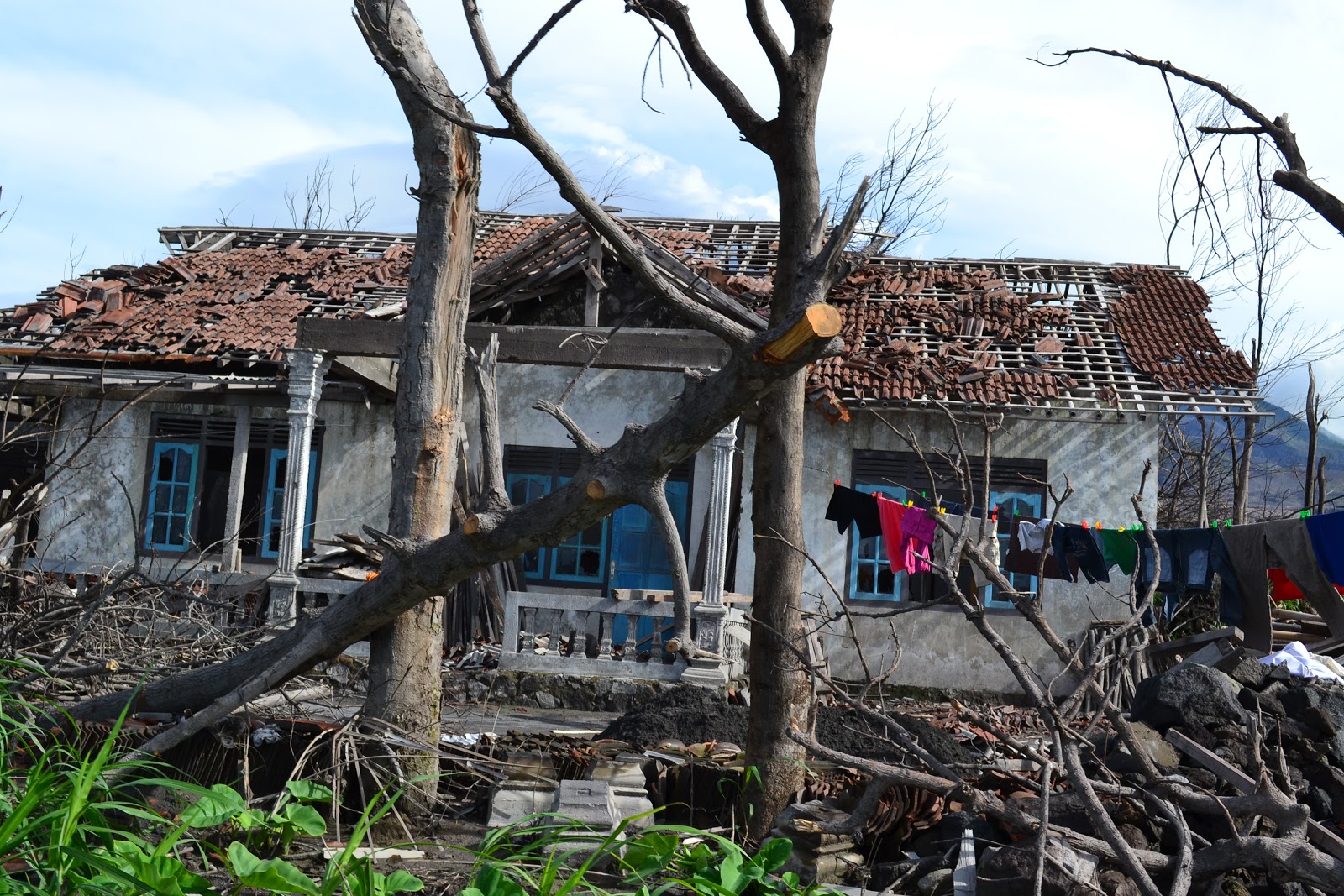 As quickly as we entered the disaster area, we left it and were traveling through brightly colored rice fields once again. These people were lucky and didn’t lose everything; however, the terror of the volcano changed them. Houses upon houses had for sale signs on them. For those people, they decided that it was best to try to rebuild a life that was not in the shadow of a volcano.
 Sunday, December 26, 2010
Merry Christmas from Indonesia
It is Christmas Eve in Indonesia, and I am sitting in my room listening to Christmas music thinking about this holiday. From my calculations, this will be my fifth Christmas spent aboard; I have spent Christmas in Taiwan, Paraguay, Panama-Costa Rica, and now Indonesia. I am always intrigued how different cultures celebrate or don't celebrate this holiday. In the small village of Paraguay that I lived in for two years, Christmas was about spending time with family. We would get together and eat and drink and be merry. In the village there were no Christmas trees, no presents, just family and food... oh and fireworks. Santa did not exist; however, on the day of the Three Kings (aka my birthday) the children received small presents. I thought it was strange when I went into the capital city that Coca Cola had a huge Santa Sleigh that drove around the city even though most Paraguayans didn't really 'do' the whole Santa thing. As I was listening to my tape of Christmas music on my Walkman (yah you can do the math and laugh, I was using a Walkman in 2003) washing my clothes by hand in the hot Paraguay sun, I laughed as I listened to White Christmas. Paraguay celebrates Christmas in the middle of summer, it was 110 degrees Fahrenheit. Who decided that the birth of Christ should be symbolized by snowflakes and evergreen trees (as my minister friend pointed out, Jesus was born in the Middle East... also not a cold place)?
This year, I wasn't expecting much from Christmas. I knew I would be spending it in a country that is predominantly Muslim. However, as I walked around town, I was surprised by how many Christmas Trees, signs wishing people a "Salamat Natal dan Tahun Baru" (Merry Christmas and Happy New Year), and store workers wearing Santa hats. I even saw fake snowflakes (which always weirds me out since most people here have never even experienced snow in their lives). In a country that is 88% Muslim and 8% Christian/ Catholic why was there such a 'Christmas' presence? Although the commercial cultural might accept Christmas, the religious meaning of this holiday was not as universally accepted. Churches were searched for bombs and police stood watch as Christians tried to celebrate an important day in their religion. This was definitely a side of Christmas that I had never seen before. I decided for my protection, that going to church would not be part of my Christmas Celebration this year. Instead, I would watch Christmas movies and spend Christmas electronically with my family (video conferencing is a great thing).
No matter where you are in the world, or how you choice to celebrate it, I wish everyone a very happy and safe holiday season.
This year, I wasn't expecting much from Christmas. I knew I would be spending it in a country that is predominantly Muslim. However, as I walked around town, I was surprised by how many Christmas Trees, signs wishing people a "Salamat Natal dan Tahun Baru" (Merry Christmas and Happy New Year), and store workers wearing Santa hats. I even saw fake snowflakes (which always weirds me out since most people here have never even experienced snow in their lives). In a country that is 88% Muslim and 8% Christian/ Catholic why was there such a 'Christmas' presence? Although the commercial cultural might accept Christmas, the religious meaning of this holiday was not as universally accepted. Churches were searched for bombs and police stood watch as Christians tried to celebrate an important day in their religion. This was definitely a side of Christmas that I had never seen before. I decided for my protection, that going to church would not be part of my Christmas Celebration this year. Instead, I would watch Christmas movies and spend Christmas electronically with my family (video conferencing is a great thing).
No matter where you are in the world, or how you choice to celebrate it, I wish everyone a very happy and safe holiday season.
Friday, December 10, 2010
The PhD Candidate Goes to Kindergarten
When I have been staring at my glowing rectangle (aka computer) writing grants, my mind often drifts to days gone by when school seemed so much easier. I remember fondly the days when school consisted of coloring, reading picture books, and playing. The past two weeks of language school has allowed me to go back to those care free days of education when one's hardest task was learning colors, numbers, and how to make simple comparisons of which lady is fatter and which tree is taller. It seems like it should be one of the easiest times in the journey to obtain my PhD. I should have mastered such things as telling time and reading numbers years ago, therefore I just need to learn the words in a new language. Well, the truth of the matter is that I have forgotten that I was not a good student till about the 5th grade, I really struggled with grades 1-4... and all those things I struggled with are coming back to haunt me.
Spelling, I can't spell in my own language that I have been speaking 'fluently' for 29ish years... how am I supposed to spell in a language that I have been learning for two weeks. I get really excited when I am one or two letters off (that means spell checker will know what I am talking about) but the language teachers do not see that as acceptable.
Telling time, I have decided long ago that a digital watch is the best method for telling time. It is quick, it is exact, and it has Indiglo. However, my language teachers insist that I practice my telling time words on a real clock. "Wait a second, which one is the hour hand and which one is the minute hand... and each number is worth how many minutes." To add insult to injury, they tell time here by saying 27 minutes till whatever o'clock, so I had to remember my simple subtraction skills also.
Left and right, I never learned my left from my right. I blame it on having pneumonia for a few weeks during kindergarten. We had multiple lessons where I had to use this skill...which person is standing to the right of Dewi, do you turn left or right if you want to go to the post office, and is the bank located to the left of the police station. I really struggled with those days. It was a constant, left, I mean right, I mean hmm, can I just say North?
I tried to explain to the teachers that it is not the language that is hard for me, it is the basic life skills that I some how missed mastering when I was younger. They don't get it and assign me piles of worksheets to do for homework, which I need to write neatly (another skill I did not master). It is a strange predicament indeed to go from planning research that has never been done before to having to answer, "The color of my shirt is blue." "Your pencil is not red." Given the choice, I think I would prefer to go back to reading journal articles and writing grants.
Tuesday, November 30, 2010
Sampai nanti Bandung
As the hot lava and ash of Volcano Merapi return to mere magma underneath the earth's crust, I too return to Yogyakarta to resume language school (and in return, I mean arrive for the first time). That means a fine farewell to the city of Bandung, the place I called home for a mere two weeks. I figured a photo montage would be the perfect way to say goodbye to Bandung.
 |
| Goodbye outlet malls with funny English names. |
 |
| Goodbye indoor waterfall in guest house. |
 |
| Goodbye traffic jams. |
 |
| Goodbye Institute Technology of Bandung |
 |
| Goodbye parking lots full of mopeds. |
 |
| Goodbye to randomness that can not be properly captured on film. |
Subscribe to:
Posts (Atom)